





Understanding the Total Cost of Security for SMBs
In the context of modern business, where digital transformation and digital adoption have become key imperatives, the role of cybersecurity is a frequent focus of discussion. But when we talk about breaches, attacks, and their costs, it’s common to think of it in the most immediate sense, such as payments extorted during ransomware attacks. Of course, this is something to be concerned about, especially as ransomware attacks are on the rise, but there are other hidden costs to security breaches that are equally important to consider, especially as a small business owner.
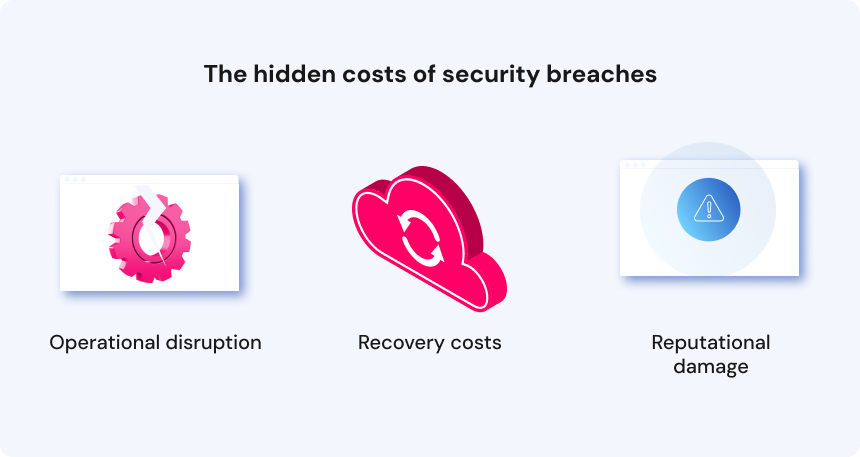
The hidden costs of security breaches
As a small business owner, even if you never have to pay a ransom, a security breach nonetheless comes with a variety of repercussions that can be financially damaging. Consider the following:
Operational disruption: If essential systems or networks become compromised due to a security breach, it can halt your operations altogether. Depending on the nature of your business and the extent of the disruption, this downtime could result in a considerable loss of revenue.
Recovery costs: Depending on the nature of a cyberattack, you might need to contract specialists to aid with recovering your data and restoring your systems to an operational state.
Reputational damage: More difficult to quantify, but a data breach can result in a loss of consumer trust, especially if customer data has been exposed. This can affect your business’s reputation and ability to generate sales.
Prevention is the most cost-effective solution
In the aftermath of an attack, all of these different costs can quickly add up. If you’re running a small business that already has narrow margins to work with, the cumulative financial strain can be too much to recover from. That’s why it’s essential to budget for security from the outset.
Of course, when it comes to spending on security solutions, you might worry about the total cost of ownership, and understandably so. It might be inconvenient to have to set resources aside for this at the beginning, but it is a worthwhile investment in stability and longevity. As the old adage goes, “a stitch in time saves nine”. It’s absolutely the case here, and what’s more, it’s relatively simple to take the first steps.
Contrary to how it may seem, you don’t need a corporate budget to establish a solid baseline of protection. In fact, there are plenty of ways to do so with relatively little investment. Even if you’re a one-man operation, you can still take effective steps to boost your security.

Affordable measures for small business security
When it comes to cybersecurity, there are many different routes you can take, and your specific needs will, of course, vary to some extent depending on the digital footprint of your business. The following, however, are solid fundamental measures that can enhance your security and help protect your business’s data without throwing your balance sheet into chaos:
- Utilize VPNs
Virtual private networks are some of the most cost-effective ways to insulate your business against cyber threats. IP tracking is a key part of how threat actors carry out reconnaissance, but a VPN will mask your company’s IPs, preventing this. Moreover, a VPN will apply high-grade encryption to all internet traffic, safeguarding important data against interception and exploitation. If you often work from different public locations or have a flexible team that works remotely, VPNs are essential. Most are very affordable these days, and there are even free options out there that can provide a good starting point.
- Implement MFA
Although cyber threats have evolved significantly over the years, hackers still utilize phishing, social engineering, and brute force tactics, and weak passwords remain one of the most common reasons for breaches. Regardless of your password policy, it’s good practice to set up multi-factor authentication as a failsafe in case credentials get compromised. Google, Microsoft, and other companies offer free basic MFA that may suit your purposes, but you may want more advanced options, which are typically paid. Prices can vary quite a bit, but there are many reasonable options on offer for low per-user-per-month fees.
- Set up a reliable backup system
A backup is one of the simplest and most effective measures for safeguarding your data. You’ll want to make sure that in the event of a breach, you have a clean, secure data backup available to you, as this will allow you to shut down compromised systems and restore your operations anew, taking leverage away from attackers. Cloud backup options are simple and convenient to use, and there are many options available. Providers like IDrive and Backblaze offer flexible, secure backups for small businesses at nominal monthly subscription fees.
Depending on the exact options you choose, you can implement all of these measures with very little increase to your overheads. For such a minimal investment, the benefits are enormous.
Summing up
In today’s digital landscape, with threats evolving and attacks consistently on the rise, no business can afford to neglect cybersecurity. Running a business in its early growth stages, your margins might be narrow, but it’s important to remember that small business security doesn’t have to be expensive, just well thought out. While you may require pricier enterprise-grade solutions down the road, there are good, affordable measures you can take to establish a solid digital defense for your business. When implemented as part of a proactive approach to cybersecurity, you’ll be surprised at just how far they can take you.


Hide your IP
With Urban Free VPN
Download Urban VPN for free and browse the web while hiding your IP address.
Free Download